REL10-BP03 Use bulkhead architectures to limit scope of impact
A failure in a shared component can spread to every request a workload handles. Bulkhead architectures, also called cell-based architectures, divide a workload into independent instances that each serve a subset of requests. Because the instances share no state, a failure is confined to one of them, so most requests continue unaffected. This containment works even for faults that would otherwise be hard to isolate.
Desired outcome:
-
Your workload runs as multiple independent cells, each serving a subset of requests.
-
A failure in one cell affects only the requests that cell handles, not the whole workload.
-
Cells share no state, and cross-cell interactions are minimal.
-
Each cell has a bounded maximum size, and you scale by adding cells rather than growing existing ones.
Common anti-patterns:
-
Teams allow cells to grow without an upper bound.
-
Teams deploy code changes to all cells at the same time.
-
Cells share state or components beyond the routing layer.
-
Teams add complex business or routing logic to the router layer.
-
Designs allow frequent cross-cell interactions that couple cells together.
Benefits of establishing this best practice:
-
Common failures, such as a bad deployment or a request that triggers a specific failure mode, stay contained within one cell.
-
The workload gains fault isolation against failure types that are otherwise hard to contain.
-
Scaling by adding cells keeps each fault domain small as demand grows.
-
A simple router layer is straightforward to test and reason about, which reduces the risk of a workload-wide failure.
Level of risk exposed if this best practice is not established: High
Implementation guidance
The bulkhead pattern takes its name from ship design, where a hull is divided into sealed sections so that a breach floods only one section rather than sinking the vessel. In technology, you use this pattern to create fault-isolated boundaries that restrict a failure to a limited set of components. Availability Zones and Regions are one form of this boundary, but you can extend the concept inside a single workload by running multiple independent copies of it. Each copy is a cell, or a self-contained instance that handles part of the traffic and shares nothing with its peers. When 10 cells serve the load and one cell fails, roughly 90 percent of requests are unaffected.
The partition key determines how requests map to cells, so it must align with the grain of the service. The grain is the natural way the workload subdivides with the fewest interactions across the divide. Customer ID and resource ID are common choices because they appear in nearly every request and rarely require one cell to talk to another. A poorly chosen key forces cross-cell interactions, and every such interaction reintroduces coupling between cells. Keep each upstream service on a single cell for the lifetime of the resource. Plan a migration path for the case where one tenant outgrows its cell.
The router layer is the one component cells cannot avoid sharing.
A fault in the router affects every cell at once, so it must stay
as simple and horizontally scalable as possible. Keep business
logic out of it, and prefer a computationally cheap mapping from
partition key to cell, such as a cryptographic hash combined with
modular arithmetic. As Colm MacCárthaigh describes in
Reliability, constant work, and a good cup of coffee
Cell size is a reliability control. A cell that grows without limit becomes a large fault domain. Establish a maximum size through load testing that pushes a cell to its breaking point. Set a safe operating margin below it, and grow the overall workload by adding cells. Stagger deployments so a faulty change reaches one cell at a time, and deploy each cell across multiple Availability Zones for common disruptions. Where the resilience requirement justifies the added complexity, deploy cells across multiple Regions for rare Region-wide events.
The following figure shows a cell-based architecture: a thin routing layer presenting a single endpoint to clients, distributing requests by partition key to independent cells that each hold their own compute and data.
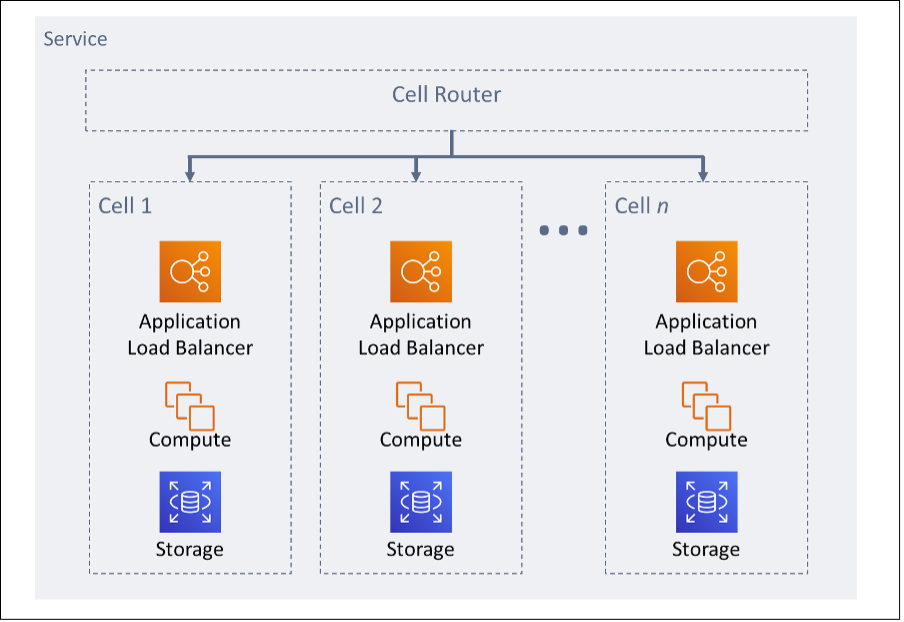
Cell-based architecture with a thin routing layer and independent cells
Implementation steps
-
Choose a partition key: Select a key that aligns with the grain of the service and subdivides the workload with minimal cross-cell interaction, such as customer ID or resource ID. Make sure the key is present in every request, either directly or through a value from which it can be derived deterministically.
-
Establish persistent cell mapping: Map each upstream resource to a single cell for the lifetime of that resource, and prevent cells from sharing state or components. Plan a migration strategy for the case where a tenant or resource outgrows its cell and needs to move.
-
Keep the router layer simple and scalable: Distribute requests with a computationally efficient mapping, such as a cryptographic hash combined with modular arithmetic, and keep business logic out of the router. Design it to scale horizontally so it does not become a shared bottleneck or a single point of failure.
-
Set a maximum cell size: Determine the ceiling through REL07-BP04 Load test your workload that drives a cell to its breaking point, then establish a safe operating margin below it. Scale the workload by adding cells rather than by letting existing cells grow.
-
Layer cells across Availability Zones and Regions: Build cells on multiple Availability Zones to handle common disruptions, and extend to REL10-BP01 Deploy the workload to multiple locations across Regions only when the resilience requirement justifies the additional complexity. Most workloads do not require a multi-Region cell design.
-
Deploy code in staggered waves across cells: Roll changes out to cells in stages rather than to all cells at once, so a faulty deployment or human error affects one cell instead of the whole workload. For patterns that make this repeatable, see Automating safe, hands-off deployments
.
Resources
Related best practices:
Related documents:
Related videos:
